Meet Our Donors
Pamela Goldsmith
Pamela Goldsmith
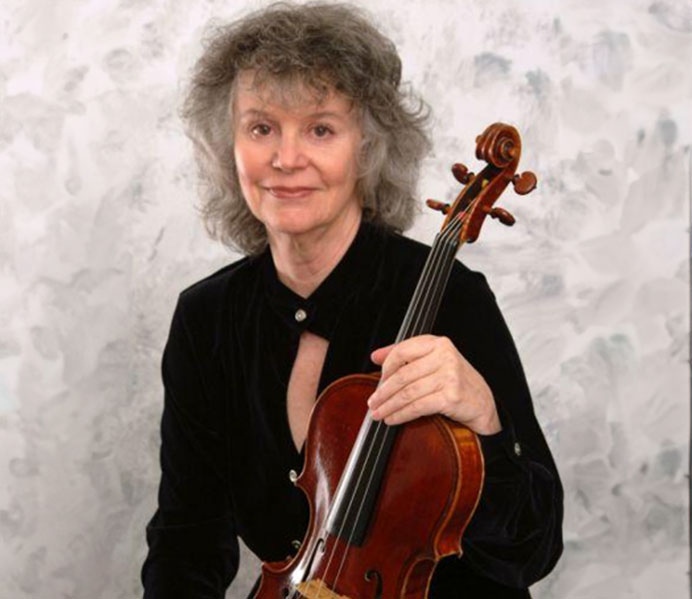
Dr. Pamela Goldsmith, a 1963 graduate of Mannes School of Music, recently announced plans to bequeath her treasured 1580’s Gasparo da Salò viola to support future generations of students.
We spoke with Dr. Goldsmith about her enduring connection to Mannes, the history of her remarkable instrument, and the inspiration behind her planned gift.
Q: What drew you from your hometown of Los Angeles to attending Mannes in New York City?
I grew up in Los Angeles, in the San Fernando Valley. I attended Van Nuys High School and played in the Burbank Youth Symphony and the Burbank Symphony.
I really wanted to go to New York City to further my career. Not that Los Angeles was a backwater — there were wonderful musicians there — but I knew that for my own growth, I had to go to New York.
My father was very reluctant to let me go, but finally he said, “If you can win a full scholarship to one of those schools in New York, I’ll let you go.”
In 1960, when I was nineteen, my closest friend, Nina de Veritch, was a cellist at Juilliard, and her father arranged an audition for me with Paul Doktor, the noted violist who taught at Mannes.
When I received a letter granting me a full-tuition scholarship, I was overjoyed. That was really the beginning of my life.
Q: What was it like to be an up-and-coming musician in New York City during that time period?
It was exciting because I never knew what was going to happen.
I played all kinds of gigs outside of school. One was with something called the Balalaika Symphony Orchestra — a whole ensemble of balalaikas playing arrangements of classical music, backed up by a string quartet, in which I was the violist.
We performed at The Town Hall, and the audience kept passing jugs of wine and baguettes through the crowd. I had to wear a Russian costume. The whole thing was incredible.
I was supposed to get paid $25, and afterward I went to the director and said, “I’m ready to get paid.” He said, “Don’t talk to me — talk to my wife.” Of course, his wife had disappeared. I finally tracked them down later and got my $25.
Q: What did your years at Mannes teach you — both musically and personally?
I loved attending school in the charming building on East 74th Street. It was a small school; everyone knew one another, and the students were supportive.
The ear training and harmony classes were demanding. I remember doing counterpoint homework while hanging onto a strap on the crosstown bus.
The primary thing I learned was how to play the viola correctly. I hadn’t had strong technical training before that. William Kroll, who coached me in chamber music, was an extraordinary teacher, and I learned a tremendous amount from him about technique and sound.
But what I especially loved was that the school encouraged us to study beyond music. I took classes in literature, pedagogy, and art history. Whenever I had free time, I visited museums.
I remember standing in front of Guernica at MoMA and becoming an anti-war activist, a Peacenik, on the spot. And I loved the Frick Collection — it felt like an oasis of quiet in the middle of the city. There was a painting of Saint Jerome, with the long white beard and enormous dark eyes that seemed to follow you across the room.
Q: Can you tell us about the viola you are bequeathing to Mannes?
My viola is very special. It’s approximately four hundred years old, made in Brescia, Italy, by Gasparo da Salò. It has double purfling, fleur-de-lis inlays on the back, and a carved head instead of a traditional scroll.
When my father died in 1968, I inherited enough money to buy a truly fine instrument. William Moennig & Son in Philadelphia — a shop I knew well — had just returned from Europe with this viola and called me personally about it.
I took the train to Philadelphia the next day. I still remember walking into the shop and smelling the sawdust and varnish. And there it was.
“Oh my,” was all I could say.
The moment I picked it up, I could sink right into it. The sound was rich and deep.
I immediately thought: this is my voice.
Q: What has this instrument meant to you over the course of your life and career?
My viola is instantly recognizable and became part of my identity. People notice it immediately and want to talk about it.
But when I returned to Los Angeles after buying it, I realized it was too precious to take into recording studios or outdoor performances. So a young violin maker built me a copy — without the decoration, of course — and I used that for commercial work.
Today, the viola lives in a large safe in my garage, though I still bring it out to play chamber music with friends.
One of those friends is Jerry Kessler, conductor of the Topanga Symphony. We met at Mannes in 1961 while studying chamber music with William Kroll, and we’re still playing together all these years later.
Q: Why was it important to you to leave this viola to Mannes?
Mannes introduced me to, and prepared me for, a career in music.
Within two years, I was performing at Carnegie Hall with Leopold Stokowski and the American Symphony Orchestra, premiering new music at Columbia University, and building relationships that lasted a lifetime.
I have always been grateful for the scholarship I received, for the education, and for the people I met there. Bequeathing my viola to the New School feels like returning the favor.